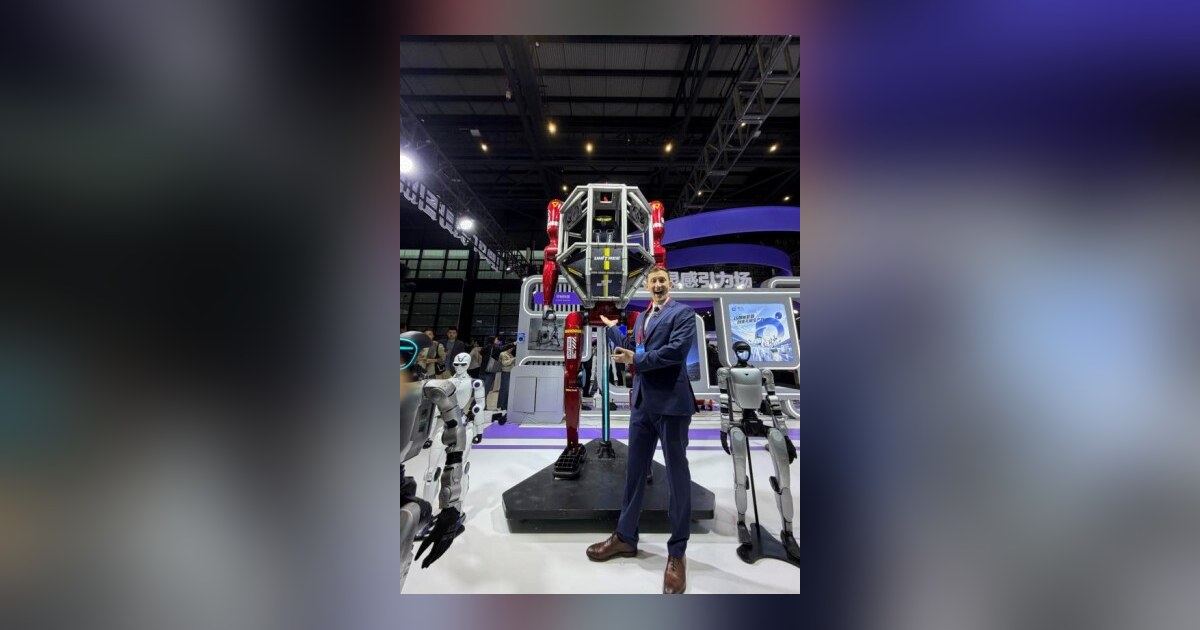
The recent World Internet Conference Wuzhen Summit, which concluded on November 5 in the canal town of Wuzhen, China, showcased a range of robots performing tasks from making coffee to dancing and patrolling exhibition halls. Companies such as Unitree Robotics, AgiBot, and UBTECH used the "Light of Internet" Expo to demonstrate how far robotics has advanced. However, the more significant story was not the spectacle itself, but the clear shift toward practical, real-world applications that could soon become part of everyday life.
Many of the machines on display were being developed for tasks beyond the exhibition floor. Evan Kail, an American content creator visiting the expo, paused in front of Unitree Robotics' GD01, a robot designed for emergency-response scenarios. Kail noted that a few years ago, Unitree robots were primarily known for dancing in televised gala performances. Now, machines like the GD01 point to more practical roles, including disaster response and search-and-rescue operations. "The leaps of technology in China are very impressive," Kail said. "As climate change gets worse and worse, robots like this can make a difference if they are used to save lives."
For robots to work reliably in crowded streets, disaster zones, or industrial sites, the machine itself is only part of the equation. It also needs a network capable of carrying huge amounts of data, responding almost instantly, and supporting AI decisions close to where they are needed. At China Mobile's booth, a display highlighted traffic-management robots deployed in Hangzhou, which hosted the 2023 Asian Games. Earlier this year, during a peak holiday travel period, Hangzhou deployed 15 robots at major intersections as part of the Hangzhou Police Smart Mobility program. These robots can answer questions, guide pedestrians and vehicles, and warn people about traffic violations. The current system uses 5G and 5G-Advanced connections and typically supports one camera per robot. Future versions are expected to carry as many as six cameras and operate more independently, requiring latency below 10 milliseconds, uplink speeds above 100 Mbps, and positioning accurate to within centimeters — demands that are helping shape the development of 6G.
The next generation of mobile technology is still years from commercial deployment, but its ambitions extend beyond faster download speeds. Industry plans for 6G include combining communications with sensing, edge computing, and satellite connectivity. "With 6G, networks will effectively gain radar-like eyes — the ability to sense and understand their surroundings — while AI will give them a brain," said Liang Zeshuai, a network optimization engineer at China Mobile Zhejiang. In this vision, a base station could detect a nearby drone, identify obstacles around a blind corner, or provide an autonomous machine with a more detailed understanding of its surroundings. Edge computing would allow AI tasks to be processed closer to the user, rather than sending every request to a distant data center. Satellite connectivity could provide another layer of resilience when disasters damage ground-based infrastructure. China Mobile has launched a direct-to-handset service using the Tiantong and BeiDou satellite systems.
For now, 5G-Advanced has already been widely rolled out across China. In Wuzhen, a 5G-Advanced "super uplink" network with upload speeds of up to 1,000 Mbps covered the conference venue for the first time, enabling robot dogs to patrol the area and transmit 4K video and location data in real time. The same combination of connectivity, computing, and AI is moving into industries where gains may be less visible but potentially more consequential. China Mobile and Sinopharm, China's state-owned pharmaceutical and healthcare conglomerate, have developed an AI-enabled cold-chain logistics platform that has reduced delivery costs by 65% and cut delivery times by 70%. At Ningbo-Zhoushan Port, China Mobile has built what it describes as the world's largest 5G private network for port operations, supporting real-time coordination among cranes, vehicles, cameras, and control systems. The company is also applying AI and connected systems to public safety and emergency management, including flood-control planning and drone inspections of buildings.
While robots remained the most visible attraction at Wuzhen, the more consequential story was happening behind them — in the networks, computing systems, and satellite links that could determine how quickly AI moves from a trade-show novelty into a tool for cities, industries, and potentially lifesaving work. As reported by Media OutReach Newswire, the summit underscored that the future of intelligent machines depends as much on connectivity as on the machines themselves.