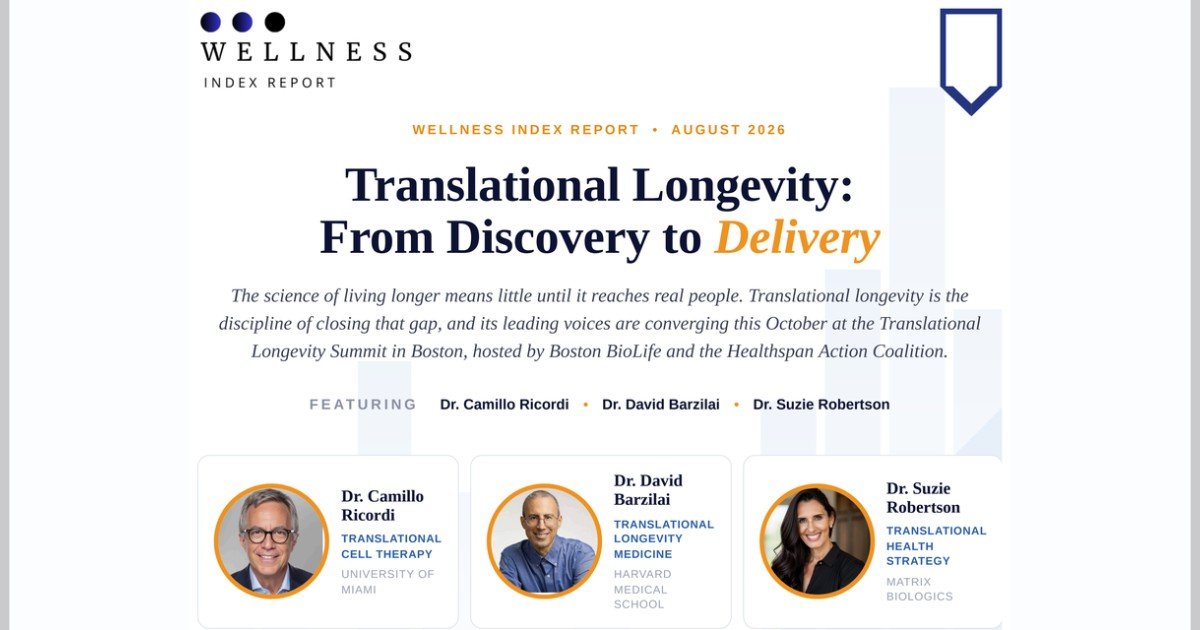
The future of longevity lies not just in scientific discovery but in the ability to translate those breakthroughs into real-world treatments that reach patients. This is the central theme of the August Wellness Index Report, published by Wellness Eternal, which focuses on the discipline of translational longevity—the work of closing the gap between laboratory research and clinical practice. The report emphasizes that while the science of living longer is advancing rapidly, its impact is only realized when it can be delivered effectively to those who need it.
The report identifies three key signals driving this field forward. First, cell science is moving from proof of concept to real clinical delivery, with decades of research in transplantation and cell therapy transitioning from specialized centers into broader longevity applications. This shift is enabling treatments that can reverse, rather than merely manage, the drivers of disease and aging. Second, evidence is emerging as the critical bridge from research to practice, as the field rewards those who can distinguish proven therapies from promising but unproven ones. Third, clinical strategy and systems are proving essential to scaling care, ensuring that even the most effective therapies can be delivered safely and consistently to patients.
The report features three experts who exemplify these trends. Dr. Camillo Ricordi, a professor at the University of Miami, anchors the first signal with his work in translational cell therapy. Dr. David Barzilai, a Harvard Medical School lecturer and longevity medicine physician, contributes his expertise in evidence-based precision medicine, making complex science accessible to clinicians and policymakers. Dr. Suzie Robertson, a clinical pharmacist and healthcare strategist at Matrix Biologics, highlights the importance of clinical excellence and operational innovation in delivering care.
These experts will converge at the Translational Longevity Summit, hosted by Joseph Krieger of Boston BioLife and Bernard Siegel of the Healthspan Action Coalition. The summit, scheduled for October 7-11 at the Harvard Enterprise Research Campus in Boston, aims to unite leaders in the field to accelerate the integration of cutting-edge technologies into everyday medical practice. Krieger, with over 25 years in healthcare and life sciences, founded Boston BioLife to streamline translational medicine, while Siegel, a patient advocate and founder of the Healthspan Action Coalition, has been instrumental in shaping the regenerative medicine landscape.
The Wellness Index Report, published monthly, evaluates wellness providers through a rigorous four-step process: expert nomination, customer feedback, clinical review, and ongoing performance tracking. This integrity-first approach ensures that only solutions meeting high standards are highlighted. The report is distributed globally, providing visibility to practitioners and companies that demonstrate a commitment to bridging the gap between discovery and delivery.
As Lindsay O'Neill-O'Keefe, founder of Wellness Eternal, notes, "Discovery is only half the job. Delivery is the rest. The future of longevity is not just discovered. It is delivered." This sentiment underscores the importance of translational longevity in making scientific progress meaningful for patients worldwide. The upcoming summit and the insights from the August report signal a growing recognition that the true measure of longevity science is its ability to improve lives.