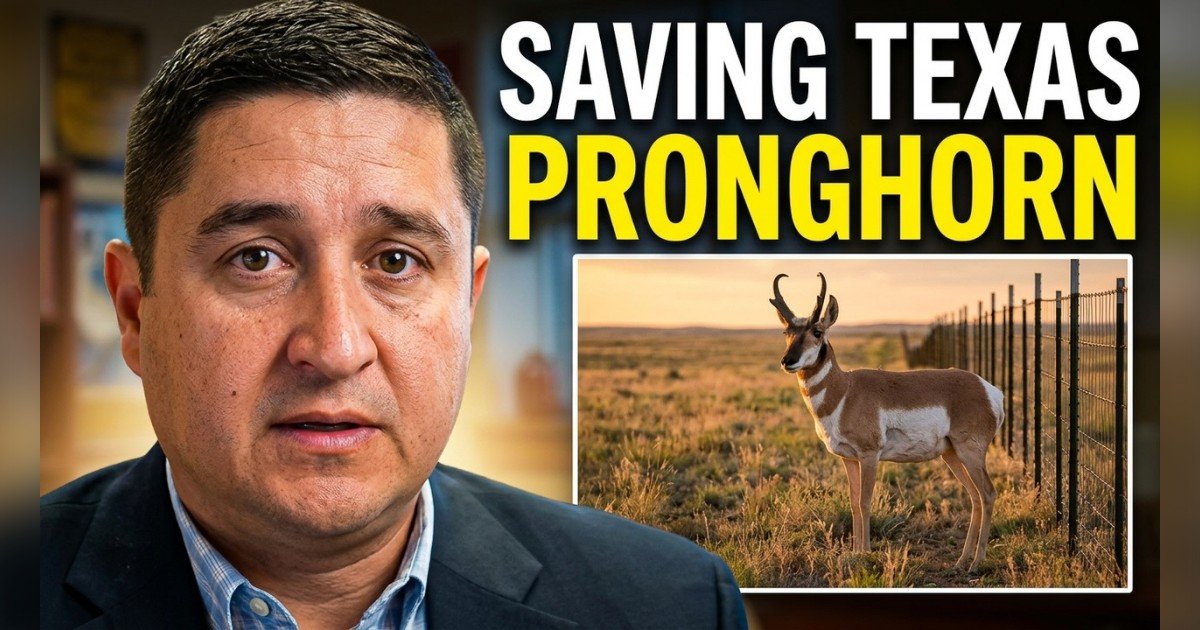
The comeback of the pronghorn antelope in West Texas and the return of the New World screwworm are two sides of the same conservation coin, according to a leading scientist at Sul Ross State University. In a recent episode of the Building Texas Show, Lalo Gonzalez, chair of the Department of Natural Sciences and a leader at the Borderlands Research Institute (BRI), detailed how these intertwined stories reveal the vulnerabilities and resilience of the Trans-Pecos landscape.
Gonzalez explained that pronghorn were pushed to the brink by fencing and brush encroachment, behaving nothing like whitetail deer. “They don’t jump fences. They physically can’t,” he said. “Any fence is a barrier, pretty much. It’s a wall that they don’t cross.” A 2010-2011 translocation program moved roughly 1,000 pronghorn from the Panhandle to the Marfa and Marathon grasslands, but the species’ recovery hinges on landowner cooperation. Gonzalez credited stewards like Nile Maxwell for opening gates, removing historic fencing, and lowering bottom wires to about 18 inches so pronghorn can slip underneath without disrupting livestock operations. In a state that is 95% privately owned, he called private landowners “the best conservationists.”
The episode also sounded an alarm about the New World screwworm, a flesh-eating fly larva that the U.S. pushed south to Panama in the 1960s using sterile-fly technology. Gonzalez noted recent positive cases in Texas livestock and confirmed wildlife cases in northern Mexico, where infected animals cross the border freely even as cattle imports have been paused. The pest’s return threatens livestock and wildlife alike, and it compounds existing pressures: the first-ever pneumonia outbreaks in Texas desert bighorn sheep, drought comparable to Death Valley in some years, and the steady loss of working landscapes from El Paso to Del Rio.
These developments matter because they signal a broader fragility in West Texas, where conservation gains are hard-won and easily reversed. BRI’s research portfolio—spanning scaled quail, black bears, mule deer, sandhill cranes, soil health, and hydrology—is central to understanding and mitigating these threats. The institute’s graduate program boasts a 95% job-placement rate at graduation, with millions of acres of West Texas serving as the classroom. That pipeline of trained scientists is essential as the region confronts a resurgence of an old pest and the slow recovery of an iconic species.
For those tracking Texas’s economic and environmental future, the conversation offers a clear takeaway: the pronghorn’s rebound and the screwworm’s return are not isolated events but indicators of how quickly a landscape can change. As Gonzalez’s work shows, the answers lie in science, landowner partnerships, and a deep understanding of the animals themselves. The full discussion is available on The Building Texas Show, where McKenzie explores the people and projects shaping the state.