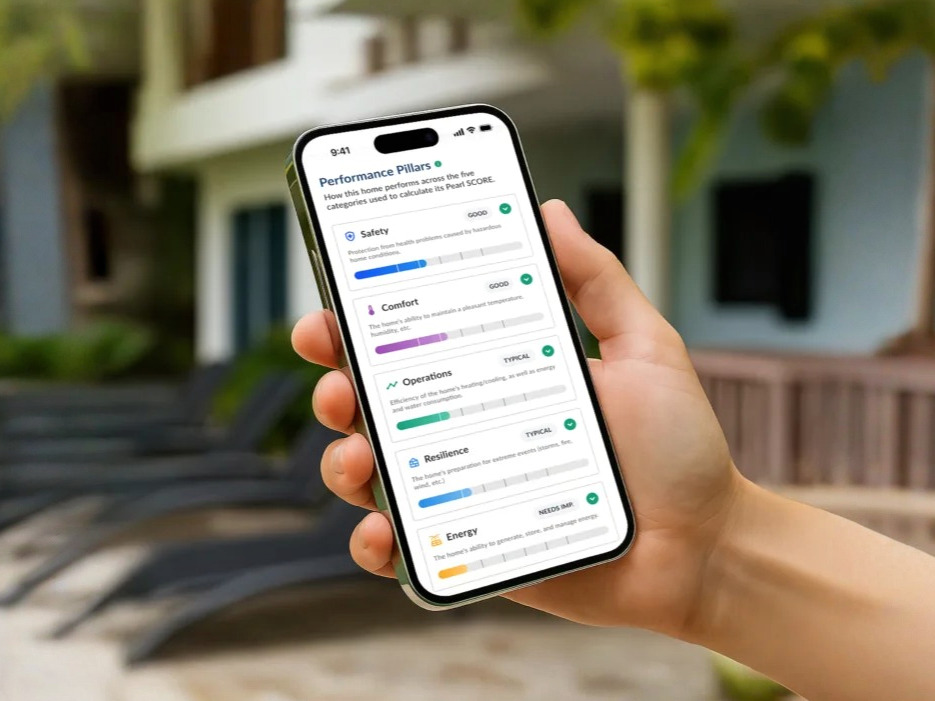
CHARLOTTESVILLE, Va. – State energy offices, municipalities, and utilities invest billions of taxpayer and ratepayer dollars annually in efficiency rebates, weatherization, electrification, and federal Home Energy Rebate programs. However, once the work is completed, evidence of the upgrade is often buried in rebate files and program records, remaining invisible to the housing market. When a home is later sold, appraised, or refinanced, that value is lost. Pearl aims to solve this problem by making its national home performance registry free for public programs.
Starting today, every improvement can be independently verified and recorded in the home’s profile in Pearl’s national registry, reflected in its Pearl SCORE™ and preserved as a permanent record that stays with the home through every sale. State energy offices, municipalities, and utilities no longer pay for this service. Pearl has provided certification services to public programs since 2019, most recently to state energy offices in connection with the Home Efficiency Rebates (HER) Program, which requires third-party certification to ensure publicly funded upgrades are completed and documented. Pearl now provides that certification at no cost for this and other public programs.
For homeowners in those programs, the benefit extends further: free access to Pearl’s homeowner tools to track their home’s performance over time, document new improvements, and keep the record on hand when the market looks for it – at resale, refinancing, and appraisal. In recent months, Pearl’s revenue model has shifted from charging fees for home certification to charging for products that serve the home transaction – for buyers, sellers, and their agents. Pearl has already dropped those fees for homeowners and, with this announcement, extends the same terms to public programs.
“Our $50 trillion housing market has a blind spot,” said Cynthia Adams, CEO of Pearl. “Give someone a car’s VIN, and they can tell you its engine, its fuel type, and its mileage. Give them a home’s address, and they can tell you little more than its size and age. We built Pearl’s registry to give every home the kind of durable record cars have always had, and making it free for public programs puts it in the hands of the agencies and homeowners who stand to benefit most.”
Pearl builds on the standards and data the industry already trusts. For example, Pearl’s energy model uses the physics engine behind the U.S. Department of Energy’s Home Energy Score. Other organizations that Pearl collaborates with include NASEO (the National Association of State Energy Officials), the National Association of REALTORS, and the Appraisal Institute. “It’s a deliberate strategy,” said Robin LeBaron, Co-founder and head of Standards and Research. “We’re building on trusted industry standards. That’s what makes a Pearl SCORE™ hold up with appraisers, lenders, and state programs. The building science isn’t ours alone. What’s new is how we put building science into tools every home in the country can use.”
This announcement is significant because it removes cost barriers for public programs, ensuring that energy upgrades are documented and can influence home valuations. By making the registry free, Pearl aims to create a permanent, accessible record of home performance improvements, which could transform how energy efficiency is valued in real estate transactions. For more information, visit pearlscore.com.