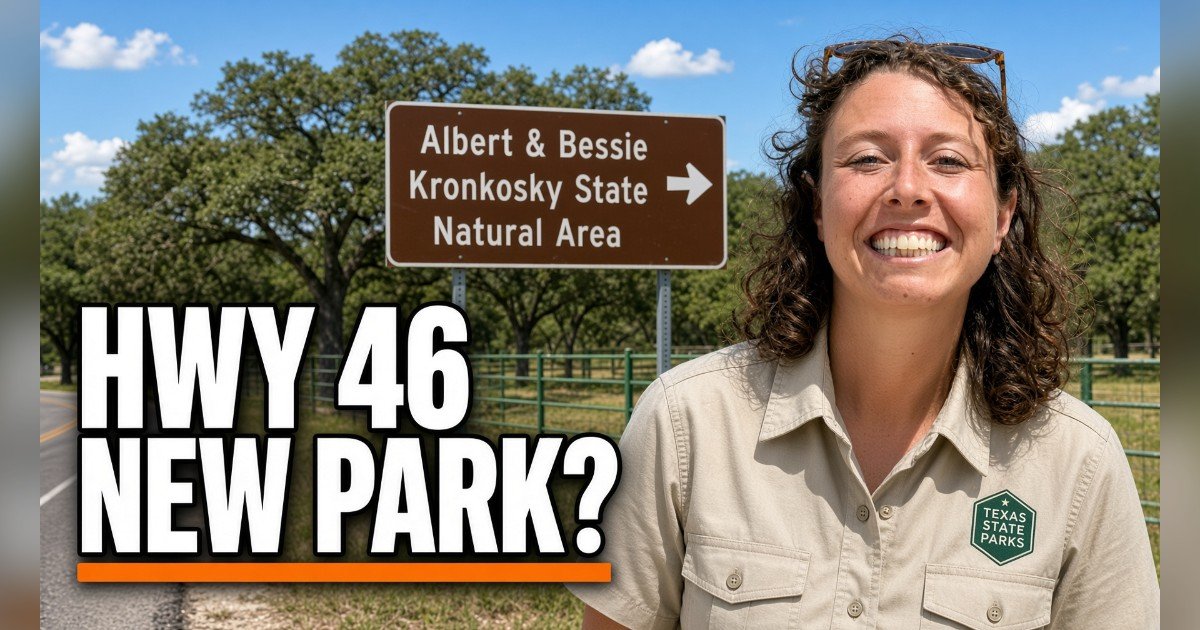
Texas Parks and Wildlife is targeting late fall 2026 to open the Albert & Bessie Kronkosky State Natural Area (ABK), a 3,814-acre site straddling Bandera and Kendall counties along Highway 46 between Boerne and Bandera. The timeline, disclosed by new site superintendent Stephanie Kwiatkowski on a recent episode of New Texas State Park Near Boerne: Why It Isn't a Park | ABK, matters because ABK is not being built as a conventional state park. It is a state natural area, a designation under the Texas Administrative Code that tilts the balance from recreation toward conservation. That distinction carries real consequences for how the land will be used, how many people can visit, and what kinds of development are permitted.
Kwiatkowski, who took the superintendent role in June, frames the park-versus-natural-area question as a spectrum. She points to Government Canyon, Lost Maples, Inks Lake, and McKinney Falls as reference points, each sitting at a different position between public access and resource protection. For ABK, the conservation side is dominant. The site protects both sides of its canyons, a viewshed Kwiatkowski described as safeguarded “forever” after viewing it from a UTV during her first weeks on site. That permanence is the core implication: once land is classified and managed as a natural area, future administrators have far less latitude to add amenities or expand visitor capacity, even if demand surges.
The ecological case for that protection is specific. ABK contains bigtooth maples that rival those at Lost Maples State Natural Area, riparian corridors along Red Bluff Creek and Pipe Creek, and transition zones between ash juniper woodlands and creek bottoms. These features are the reason the property was acquired and the reason its public opening is being staged carefully. The site will still offer recreation: 28 miles of multi-use trail for hikers, mountain bikers, joggers, and strollers, plus cabins, screened shelters, tent sites, backcountry camping, and hike-and-bike infrastructure now being prepared by construction crews, subcontractors, and a six-person site team.
But the operational risks are also instructive. A July 2026 flooding event washed out landscaping, trails, and campsites before any public visitation had occurred. Kwiatkowski discusses the lessons learned from that episode, which underscore why the agency is not rushing the opening. For surrounding communities, the delay is not merely bureaucratic. A natural area that opens slowly and manages tightly may generate fewer visitors than a state park, but it also promises longer-term protection of water quality, wildlife habitat, and the rural character that draws people to the Hill Country in the first place.
The staffing story reinforces the conservation emphasis. Kwiatkowski credits the volunteer corps assembled by founding superintendent James Rice, a former biologist, calling those relationships “integral to our success as a site.” Her own path ran from childhood camping to an environmental science degree, GIS and consulting work, a seasonal job with New Braunfels parks, a park operations traineeship at the Lost Pines Complex, and an assistant superintendent stint at Pedernales Falls before her promotion. That background suggests ABK will be run by someone fluent in both public engagement and resource management.
For listeners tracking Texas land policy, the episode is a case study in how the state is choosing to absorb growth. The ABK model may become a template for future acquisitions where conservation values outweigh visitor volume. More broadly, the discussion fits the mandate of The Building Texas Show, which examines the people and projects shaping Texas communities. The opening date is still a target, not a guarantee, but the direction is clear: ABK will open as a place where the viewshed comes first.