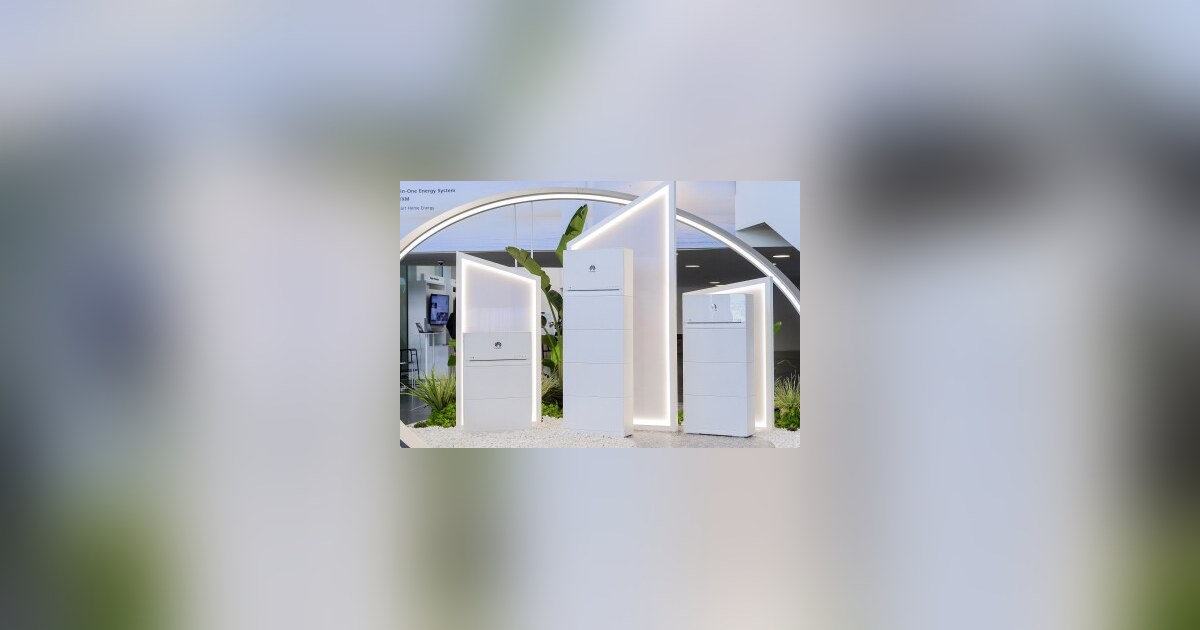
Huawei has unveiled the HUAWEI LUTERRA S2, an all-in-one residential energy system that integrates a hybrid inverter, battery storage, and AI-powered energy management into a single stackable unit. The announcement, made at a launch event in Palma, Spain, positions the LUTERRA S2 as the industry's first all-in-one residential energy system built on Huawei's proprietary full-silicon carbide (SiC) architecture, a move that could accelerate the convergence of solar, storage, EV charging, and home energy management.
The significance of the LUTERRA S2 lies in its potential to simplify and supercharge home energy systems. Traditional residential setups often require separate components from multiple vendors, leading to inefficiencies and complex installations. By integrating everything into one unit that can be installed and commissioned in minutes, Huawei aims to lower barriers for homeowners and installers alike. The system is available in single-phase (3-10 kW) and three-phase (5-20 kW) configurations, with the three-phase version delivering 20 kW-class power in a compact form factor. Huawei claims up to 99% efficiency, a design lifespan of more than 15 years, and a fanless cooling design that keeps noise below 29 dB.
At the heart of the LUTERRA S2 is Huawei's AI Energy Management 2.0 platform, which coordinates photovoltaic systems, energy storage, EV charging, heat pumps, and virtual power plants (VPPs) by integrating weather forecasts, electricity prices, household loads, and energy status. This active decision-making capability could maximize the value of every kilowatt-hour generated, stored, and consumed, shifting residential energy from simple automation to intelligent optimization. For homeowners, an AI Assistant enables conversational interactions, while installers benefit from AI 3D modeling and AI-powered diagnostics.
Safety is another critical pillar. The LUTERRA S2 incorporates cell-level protective isolation, an intelligent smoke-duct design, and continuous AC and DC terminal temperature detection. It has been validated against EU Battery Regulation requirements and complies with IEC 63027 AFCI, and has undergone TÜV Rheinland testing including a cell thermal runaway test, a 20-minute fire test at 1,000°C, and a 20% hydrogen explosion test. The system has received TÜV Rheinland's highest-level Safety Mark certification, backed by industry-first cell-level thermal insulation and safety venting designs. These certifications matter because they address growing consumer and regulatory concerns about battery safety in homes.
The LUTERRA S2 also supports up to three inverters in parallel for 60 kW max and up to 48 battery packs in parallel for 336 kWh max, with backup switchover under 10 ms and up to 20 kW off-grid load. Connectivity options include EEBUS, SG-Ready, OCPP, and Modbus-TCP. More information is available at https://solar.huawei.com/en/products/luterra-s2-xl-xm/.
As residential energy systems evolve from standalone components to integrated, intelligent platforms, Huawei's move could pressure competitors to follow suit, ultimately giving homeowners more capable and safer options. The LUTERRA S2 represents a step toward a smarter, more sustainable future for home energy.