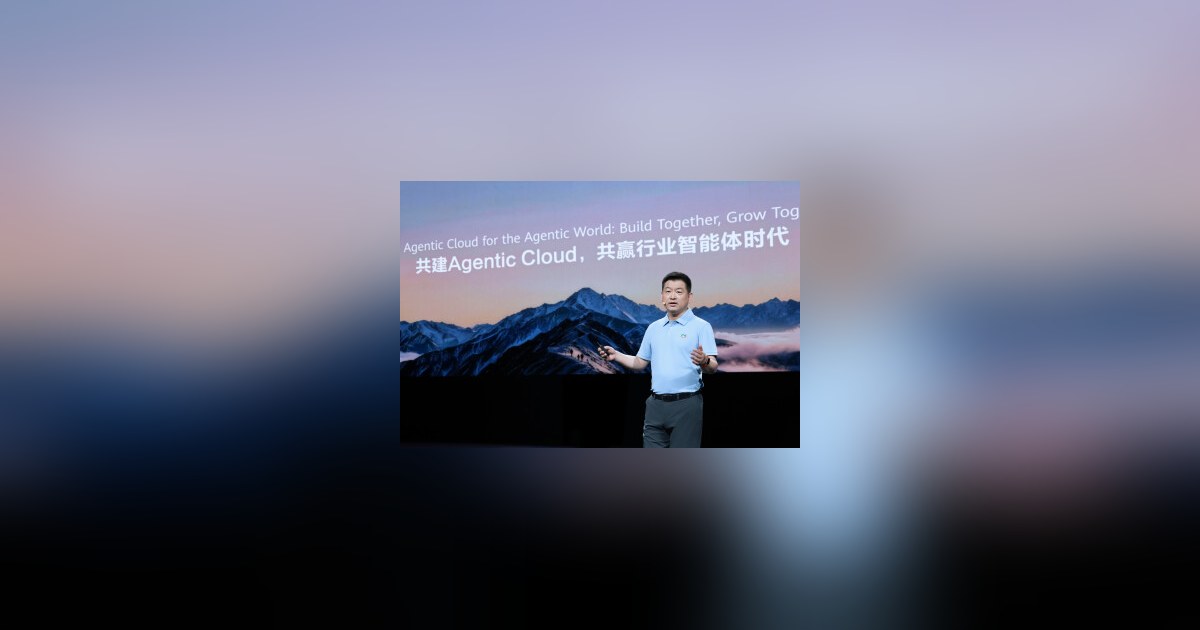
At HUAWEI CONNECT 2026 in Shanghai, Huawei Cloud announced a comprehensive expansion of its enterprise AI offerings, positioning itself at the forefront of the emerging agentic AI era. Dr. Peter Zhou, Director of the Board at Huawei and CEO of Huawei Cloud, delivered a keynote titled "The Agentic Cloud for the Agentic World: Build Together, Grow Together," outlining a strategy that spans infrastructure, platforms, and industry ecosystems. The announcements matter because they signal a significant shift in how enterprises will develop, deploy, and scale AI agents, moving from experimental projects to production-grade systems that can operate autonomously and efficiently.
Central to the launch is the global availability of the latest AI Cluster Service (AICS), a key component of Huawei Cloud's strategy to strengthen the silicon bedrock on the cloud. According to Dr. Zhou, in the agentic era, infrastructure must do more than provide compute; it must make every token more efficient, coordinate general and AI compute, enable continuous model learning, and run agents securely in real production environments. The new AICS, built on a five-level fast recovery mechanism with full-chain observability, supports over 40 days of stable training on cloud and can recover from faults within 10 minutes. It delivers 20% higher token throughput than the previous generation. The service will be commercially available in China on September 30 and in international markets on November 30. For more details on HUAWEI CONNECT 2026, visit https://www.huawei.com/en/events/huaweiconnect.
Alongside AICS, Huawei Cloud introduced the Context Memory Storage (CMS) solution, designed to address the memory capacity and access efficiency needs of long-horizon agent tasks. CMS provides petabyte-scale memory space, twice the storage capacity of comparable industry products, and supports high-speed terabyte-scale memory reads with 50% higher performance than industry peers. This infrastructure layer is critical for enabling agents to handle complex, multi-step tasks that require sustained context and rapid data retrieval.
On the platform side, Huawei Cloud is advancing its Agentic Model as a Service (MaaS) and the AgentArts enterprise-grade agent platform. The Agentic MaaS brings together diverse models, allowing developers to invoke state-of-the-art models from leading providers with just one click and no deployment required. At the event, MiniMax demonstrated its advanced multimodal model, which, combined with Huawei Cloud, delivers open, cutting-edge multimodal capabilities. The AgentArts platform, built on AgentArts and its open-source edition openJiuwen, opens up more than 5,000 general Model Context Protocol (MCP) assets and over 1,000 industry-specific MCP assets. It has already served more than 100 customers, including the Shenzhen Longgang District Government, China Southern Power Grid, and Kingsoft Office. Kingsoft Office shared how it integrated the agent platform with WPS 365 Document Center and WPS Comate to build vertical office agents deployed across finance and government sectors. AgentArts will be commercially available outside China on December 30, and the openJiuwen community has surpassed 50,000 stars and 3.29 million downloads.
Huawei Cloud also announced the expansion of its Industry AI Foundry with two new zones: the Smart Government Zone and the AI Hardware Zone. The Smart Government Zone has already brought together 24 founding partners, covering scenarios such as government office operations, public services, urban governance, and industry development. The AI Hardware Zone has onboarded 15 core partners, covering more than 20 device types, including AI glasses, AI toys, and AI recording cards, along with over 10 scenario templates and more than 110 scenario skills. The Industry AI Foundry now includes five industry-specific zones—Smart Healthcare, Embodied AI, AI for Science (AI4S), Smart Manufacturing, and Smart Finance—with over 1,000 industry-specific assets and more than 1,000 deployed projects.
These efforts collectively build an open agentic cloud that spans open infrastructure, an open platform, and an open industry ecosystem. By lowering the barriers to developing and deploying AI agents, Huawei Cloud aims to accelerate AI adoption at scale across industries. The implications are profound: enterprises can now leverage pre-built industry assets, partner editions, and a robust infrastructure to move from isolated AI experiments to production-grade agentic systems. As Dr. Zhou emphasized, the goal is to move forward with customers and partners to build and grow together in the agentic era, making AI more accessible, efficient, and impactful for businesses worldwide.