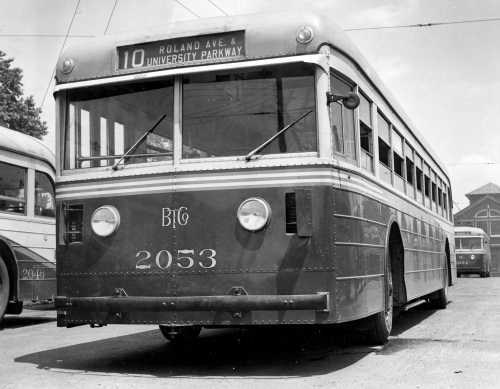
A. Aubrey Bodine's 1940 photograph of the Baltimore Transit Company's fleet at Carroll Park offers a window into mid-20th century urban transportation and the photographer's unique artistic approach. The image, titled “Baltimore Transit Company (1940),” captures buses of the Roland Avenue and University Parkway line awaiting mechanical attention, revealing the everyday machinery that kept the city moving. Bodine's work transcends typical newspaper photography, merging documentary realism with pictorialist artistry, a combination that earned him international acclaim.
Bodine, a photographer for the Baltimore Sunday Sun from 1923, documented Maryland's people and places with an eye for composition and lighting. He studied art at the Maryland Institute College of Art and treated his camera and darkroom as tools for creative expression, often manipulating negatives through dyes, intensifiers, and scraping to achieve desired effects. His philosophy, as stated on his website, was that “the picture was the thing, not the manner of arriving at it,” emphasizing that he “made” rather than “took” pictures.
This particular photograph is part of a vast collection of over 6,000 images spanning Bodine's 47-year career, now viewable at www.aaubreybodine.com. The website allows visitors to order reprints and note cards of his work. The image of the Baltimore Transit Company is identified by ID# 48-460, and can be requested through the site. Bodine's biography, “A Legend In His Time” by Harold A. Williams, is also available on the site, offering deeper insight into the photographer's life and methods.
The significance of Bodine's work lies in its dual role as historical record and artistic achievement. His images, like this one of the transit company, preserve the texture of mid-century Baltimore while demonstrating the creative potential of photography. For historians and art lovers alike, Bodine's archive provides a rich resource for understanding the era's visual culture. The ability to access and purchase these images ensures that Bodine's legacy continues to inspire new generations.