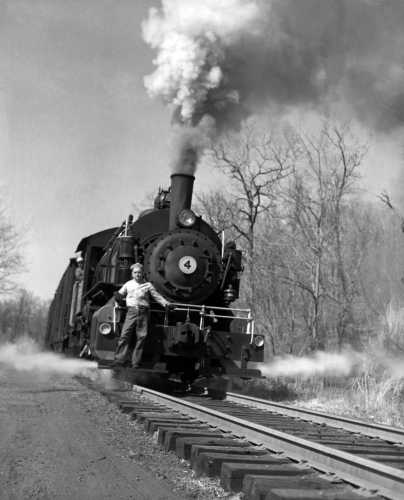
In 1959, photographer A. Aubrey Bodine captured an image titled "The Railroad that Stuck to Steam," documenting a 50-ton Porter saddle tank steam locomotive still operating on the grounds of St. Elizabeth’s Hospital in Washington, D.C. The locomotive, the line’s fourth engine, was built ten years prior at a cost of $45,000, and it continued to move coal cars along a line less than a mile long. This photograph, available for viewing and purchase at www.aaubreybodine.com, not only captures a piece of industrial history but also exemplifies Bodine’s mastery of pictorialist photography.
Bodine, regarded as one of the finest pictorialists of the twentieth century, began his career in 1923 with the Baltimore Sunday Sun. He traveled throughout Maryland, creating documentary pictures of remarkable quality, often artistic in design and lighting beyond typical newspaper standards. His work earned top honors in national and international salons. Bodine believed photography could be a creative discipline and studied art principles at the Maryland Institute College of Art. He experimented with tools, composing pictures in the viewfinder or manipulating negatives with dyes, intensifiers, and scraping to achieve his vision. He added clouds photographically and made other elaborate alterations, arguing that like a painter, he selected features to suit his sense of mood, proportion, and design. "He did not take a picture, he made a picture," as noted in his biography.
The significance of this photograph lies in its documentation of a bygone era: a steam locomotive still in service decades after diesel engines had become standard. St. Elizabeth’s Hospital, a federal psychiatric facility, maintained this short line for coal delivery, a practical necessity that preserved a piece of railroad history. Bodine’s image captures not just a machine but a moment in time when old technology persisted amid modernity. The full biography of Bodine, written by his editor Harold A. Williams, is available on the website. More than 6,000 photographs from Bodine’s 47-year career are accessible at www.aaubreybodine.com, where reprints and note cards can be ordered.
This photograph matters because it serves as a visual record of industrial heritage and the artistic vision of a photographer who elevated documentary work to fine art. It reminds viewers of the persistence of older technologies and the stories embedded in everyday scenes. Bodine’s work, including this image, continues to be a valuable resource for historians, railroad enthusiasts, and art lovers alike.