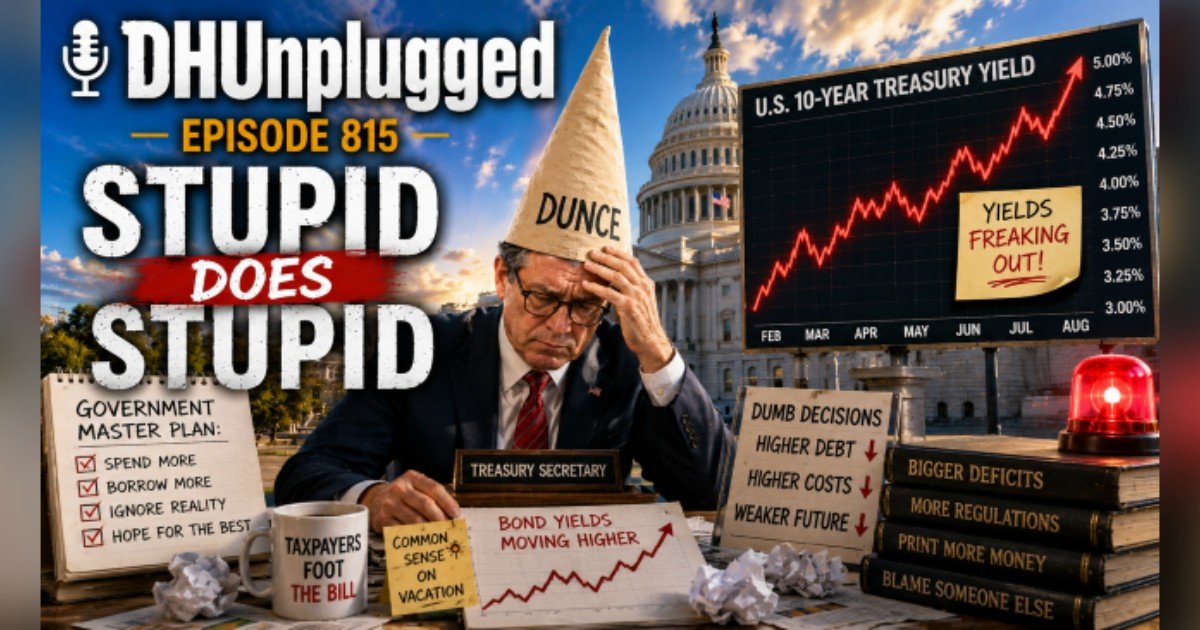
The latest episode of DH Unplugged, titled "Stupid Does Stupid," delivers a sharp critique of what hosts Andrew Horowitz and JC Dvorak call the five dumbest moves currently shaking financial markets. Published August 25, 2026, the episode arrives days before NVIDIA's earnings report and the Jackson Hole symposium, framing a week where Treasury maneuvers, tariff reversals, and a weakening dollar collide with sky-high AI expectations.
The hosts quickly dismantle Treasury Secretary Scott Bessent's expanded long-bond buybacks, dubbing it "Bessent's Big Bond Blunder." Horowitz argues, "There is no quantitative easing going on. The dollar is down, but not that much. The fact is that everybody just wants to buy it. This is an excuse." Dvorak counters that if retail believes the story, image control is working, even though rates snapped back after Bessent hinted the $4 billion monthly pace could climb. They also flag unusual TLT inflows on August 18, the day before the announcement, calling it "information leakage."
Next, they examine Trump's tariff cut on imported beef, questioning who actually pays tariffs. The hosts suggest the move is political, but the economic impact remains unclear, especially as other tariffs persist.
The episode also covers new Iran sanctions targeting roughly 60 individuals and entities under "Operation Economic Outcast," which could tighten oil supplies. Bitcoin's surge past $80,000 and gold's rise on a softer dollar are discussed, but the hosts dismiss the debasement trade as overhyped.
Walmart's consumer warning, with U.S. comparable sales up just 2.6% against ~3% inflation, is highlighted as a credible recession signal. Dvorak, who consults with Walmart's data science team, argues their predictive models make the caution real, not spin. He also notes Costco's earlier warning about shoppers swapping chicken for tuna as another tell.
On NVIDIA, the hosts spotlight Kingslide Works, the Taiwanese maker of ~70% of data center rack slides, up ~400% in a year, as an early indicator ahead of the Ultra Rubin chip cycle. They also discuss Venezuelan oil refining bottlenecks, strategic petroleum reserves near 1983 levels, salt-cavern risks in Texas and Louisiana, and China's 90% share of Iranian oil imports.
Horowitz and Dvorak urge investors to look beyond surface narratives and consider the interconnected risks. The episode is available now via DH Unplugged and major podcast platforms.