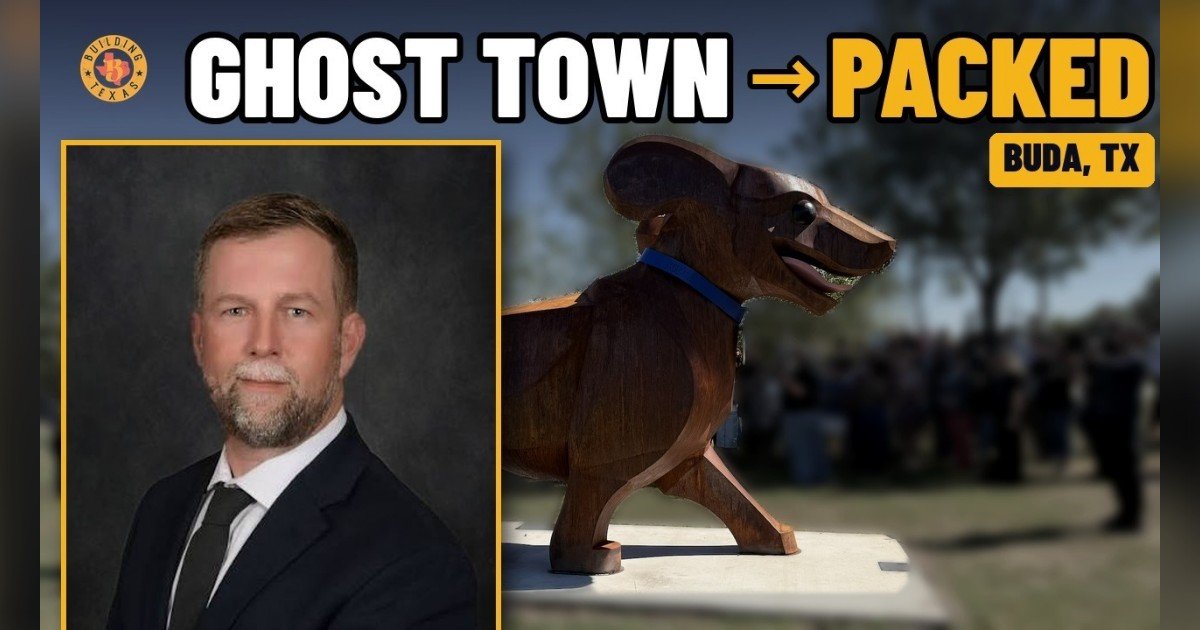
Buda Mayor Lee Urbanovsky’s appearance on The Building Texas Show offers a case study in how a fast-growing suburb between Austin and San Marcos is planning decades ahead, with lessons for other communities facing rapid growth. In the episode, This Austin Suburb Was a Ghost Town. Now It’s Packed Every Weekend, Urbanovsky tells host Justin McKenzie that consistency in the city’s development process is what he is proudest of. “We can do it slow if we have to, but we need to be consistent and predictable,” he says, a philosophy shaped by his career in development and construction.
That predictability matters because Buda is no longer the quiet town Urbanovsky moved to in 2000, about a month before H-E-B opened. Back then, downtown “was a ghost town after about 6:00.” Today he likes to sit on Main Street on a Friday or Saturday “just watch people, because it’s people I don’t know, which is amazing.” The transformation is the heart of the conversation and the clearest signal of why the city’s approach has implications beyond its borders: downtown revitalization can be engineered through deliberate policy and partnership rather than left to chance.
The episode covers projects that follow from that long view. Garison Park, on land Urbanovsky says the city bought in 2016, will open access to Onion Creek, one of the city’s most beautiful gems in his words. Buda Championship Park, formerly the Sportsplex, has been expanded to eight softball fields with grandstands and turf improvements and hosted a soft-opening event with the Pony World Series. The 2021 bond projects on Goforth Road, Old Black Colony Road and Austin Street—which runs parallel to Main Street and could become a second downtown corridor—illustrate how infrastructure spending is being sequenced to accommodate growth.
Urbanovsky credits collaboration among the City of Buda, the Greater Buda Chamber of Commerce and the Buda Economic Development Corporation for the downtown revival. He says the EDC started during COVID when the city found ways to support small businesses. McKenzie gives “Monica and the chamber a big shout-out” for bringing business collaboration back to life over the last two years, a reference to Monica Davidson, CEO of the Greater Buda Chamber of Commerce and a Buda City Council member. Urbanovsky agrees that “the collaboration between the chamber and the EDC and the city council as a whole has made huge strides,” adding that “Monica and Jennifer absolutely made a huge part of that,” referring to Davidson and Jennifer Storm, CEO of the Buda Economic Development Corporation.
The wider implication is that Buda’s model—consistent rules, long-range land acquisition, bond-funded infrastructure, and tight coordination between elected officials and business groups—offers a template for other Texas suburbs trying to manage growth without losing the character that attracted residents in the first place. The episode wraps with live music at the Buda Amphitheater & City Park, including September’s Railcar Revival music festival, and Urbanovsky’s invitation for residents to get involved through the EDC, the chamber or by reaching out to him directly. His advice to new council members is simple: “do your homework and be available.” For listeners interested in the broader series, The Building Texas Show publishes new episodes weekly.