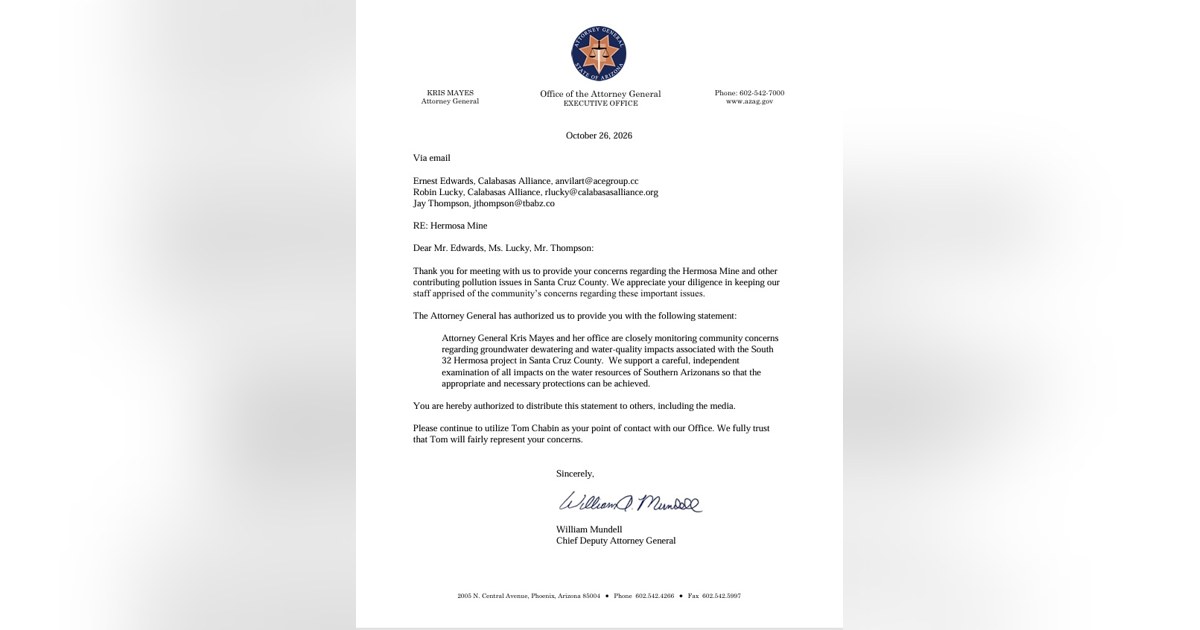
The Office of Arizona Attorney General Kris Mayes has acknowledged community concerns about groundwater dewatering and water-quality impacts tied to the South32 Hermosa Project in Santa Cruz County, lending official weight to a growing push for independent scientific review of the mine's effects on Southern Arizona's water resources. The statement, released by the Calabasas Alliance, follows the submission of background information, data, and letters from community members, and signals that state-level scrutiny of the project is intensifying.
The significance of the attorney general's acknowledgment lies in its timing and tone. Mayes' office not only recognized the concerns but also backed a careful, independent examination of the project's effects on Southern Arizona's water, according to the statement. That endorsement matters because it elevates what has been a local dispute into a matter of statewide water policy, potentially increasing pressure on regulators and the company to justify their modeling and mitigation plans. For residents of Santa Cruz County, the support offers a measure of validation and a possible lever for securing protections before what local leaders describe as irreversible damage occurs.
Community members, technical experts, and researchers have identified gaps in assessing long-term dewatering effects, contaminant pathways, and cumulative impacts on aquifers and surface waters. Those gaps have prompted the Calabasas Alliance to demand transparent, independently verified science rather than reliance on project-sponsored modeling. The group, a grassroots organization dedicated to protecting land, air, and water resources and public health, has been gathering data and mobilizing residents to press for greater accountability. Its efforts are detailed in the full announcement, which is available through the click here link provided by the Alliance.
Local leaders warn that high-volume dewatering could create a cone of depression that lowers groundwater levels, threatens wells and surface flows around Patagonia Lake, and necessitates immediate independent hydrologic analysis. Such a cone of depression could extend beyond the immediate mine area, drawing down aquifers that supply homes, ranches, and ecosystems, and reducing the baseflow that sustains streams and the lake. The concern is not abstract: dewatering, the process of removing groundwater to keep mine workings dry, can alter the direction and speed of groundwater flow, potentially mobilizing contaminants and changing water quality far from the site. Without independent verification, residents argue, the true scale of these risks remains unknown.
The Calabasas Alliance's work is not limited to advocacy. The organization participates in the Arizona State University/University of Arizona AirSMART air-quality monitoring program, is a member of the Arizona Department of Environmental Quality Citizen Science Alliance, and recently received a mobile water-testing laboratory through Arizona State University's Water for All program. It is also a stakeholder in university forums on PFAS and participates in the Arizona Rural Water Working Group. These credentials underscore the group's technical capacity to engage with complex hydrologic and public-health questions, and they strengthen its call for independent analysis. More information about the organization is available at Calabasas Alliance.
The implications of the attorney general's support extend beyond Santa Cruz County. As Arizona confronts persistent drought and competing demands on limited water supplies, the Hermosa Project could set a precedent for how mining projects are evaluated in water-scarce regions. If Mayes' office remains engaged, it may encourage other communities to seek similar independent reviews, and it could prompt companies to adopt more transparent, science-based approaches to water management. For now, the Alliance and its allies are pressing for action before dewatering begins in earnest, arguing that the cost of waiting could be measured in lost wells, diminished flows, and long-term harm to public health.