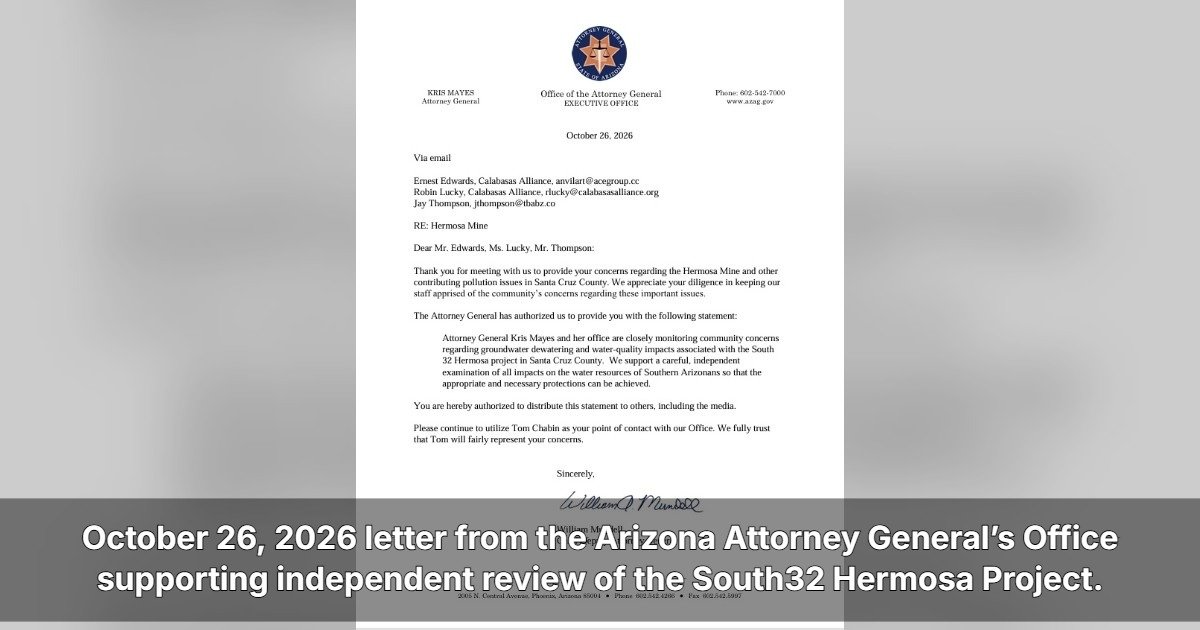
The Office of Arizona Attorney General Kris Mayes has acknowledged community concerns about groundwater dewatering and water-quality impacts tied to the South32 Hermosa Project in Santa Cruz County, according to a statement released by the Calabasas Alliance. The attorney general's office said it supports a careful, independent examination of all impacts on Southern Arizona's water resources so that necessary protections can be achieved.
The statement, transmitted in a letter dated October 26, 2026, from Chief Deputy Attorney General William Mundell, was expressly authorized for public distribution. It follows the submission of background information, data, and letters from community members who have raised concerns about the project's long-term effects on local aquifers and surface waters.
The significance of the attorney general's acknowledgment lies in its potential to shift the debate over the Hermosa Project from project-sponsored modeling to independent scientific scrutiny. The Calabasas Alliance has argued that conclusions about groundwater drawdown, aquifer connectivity, and water quality must be transparent, independently verified, and capable of withstanding rigorous technical and public scrutiny. The organization maintains that findings on dewatering rates, the resulting cone of depression, and reported antimony and arsenic levels should be cross-checked against regulatory datasets, peer-reviewed university research, and transparent public data sources.
Community leaders say the implications for residents are direct and urgent. Ernie Edwards, a Lake Patagonia resident and president of the "B" Property Owners Association, warned that high-volume pumping will lower groundwater levels across a wide area, affecting wells, surface flows into the lake, and the connected aquifers that supply the community and the Santa Cruz Active Management Area. He called for independent hydrologic analysis now, rather than relying solely on South32 consultant models, to understand the full extent of these impacts before irreversible drawdown or ground subsidence occurs.
Robin Lucky, president of the Calabasas Alliance, said the attorney general's recognition that community concerns warrant independent examination is greatly appreciated. Lucky noted that massive dewatering will alter aquifer levels for decades and that questions remain about arsenic and other heavy metals in wells, as well as broader impacts in the county. Lucky added that these concerns compound Santa Cruz County's longstanding pollution challenges, including some of the highest PFAS levels detected in Arizona drinking water, according to EPA and ADEQ reports, and poor air quality in Nogales documented by the same agencies.
The attorney general's statement does not itself impose new regulations or halt the project, but it signals that state-level scrutiny of the mine's water impacts is now formally on the record. For Southern Arizona communities, the development raises the prospect that decisions about the Hermosa Project will rest on the best available science and that protections for land, air, water, and public health will be secured before irreversible harm occurs.