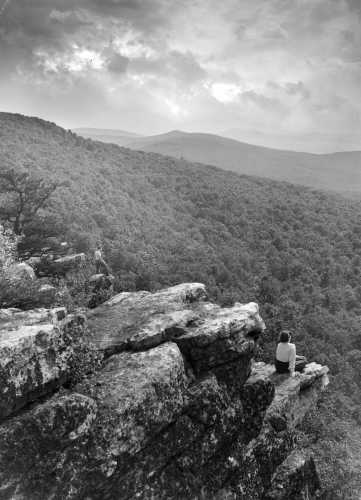
A. Aubrey Bodine's photograph "Annapolis Rock (1948)" captures a striking view of South Mountain, the ridge dividing Frederick County and Washington County in Maryland. The image, available for viewing and purchase at www.aaubreybodine.com, exemplifies Bodine's ability to transform a documentary scene into a work of art. This photograph is part of a vast collection of over 6,000 images from his 47-year career, offering a window into mid-20th century Maryland.
Bodine, who began his photography career in 1923 with the Baltimore Sunday Sun, was celebrated globally as one of the finest pictorialists of the twentieth century. His work earned top honors in numerous international salons and exhibitions. Unlike standard newspaper photographers, Bodine approached his craft with an artist's sensibility. He studied principles of art at the Maryland Institute College of Art and used his camera and darkroom tools as a painter uses brushes. His pictures were not merely taken but "made," involving meticulous composition in the viewfinder, manipulation of negatives with dyes and intensifiers, and even scraping to achieve desired effects. He would add clouds photographically and make other elaborate alterations, all with the rationale that the final image mattered most, not the method of creation.
The significance of "Annapolis Rock (1948)" lies in its representation of Bodine's dual legacy: as a documentarian of Maryland's people and places, and as a pioneering artist who elevated photography to a creative discipline. His work captures a bygone era with remarkable quality, blending artistic design with lighting effects that go beyond typical newspaper work. The photograph invites viewers to appreciate the natural beauty of South Mountain while recognizing the skill behind the image.
For those interested in learning more about Bodine, the full biography "A Legend In His Time" by Harold A. Williams, his editor and closest friend, is available on the website. The site also offers reprints and note cards of his photographs. This enduring collection ensures that Bodine's contributions to photography remain accessible to new generations, underscoring the importance of preserving and studying historical photographic art.